Don't Know How to Start a Research Paper? Here's What to Do First
You have a research paper due, a blank document open, and no idea what to write first. Maybe you have a topic but can't find the right sources. Or perhaps you've spent an hour staring at the assignment instructions without typing a single sentence.
If you're wondering how to start a research paper, you're not alone. The hardest part is often figuring out what to do before writing the introduction.
The good news? You don't need a perfect thesis statement, ten sources, or a polished opening paragraph to begin. You need a clear direction and a few manageable steps.
This guide will show you exactly where to start, even if your deadline is approaching and your ideas are still scattered.
How to Start a Research Paper When You Have No Idea What to Write
Before you type your first paragraph, stop trying to make your paper sound academic. Your first task is to understand what your professor expects.
Open your assignment instructions and answer these five questions:
- What question or problem should the paper address?
- How many pages or words are required?
- How many academic sources do you need?
- Which citation style should you follow?
- When is the paper due?
Write these answers at the top of a working document.
For example, suppose your professor assigns an eight-page research paper about social media and college students. You have two weeks to complete it and must include at least six scholarly sources in APA format.
Now you have a defined assignment rather than an overwhelming project.
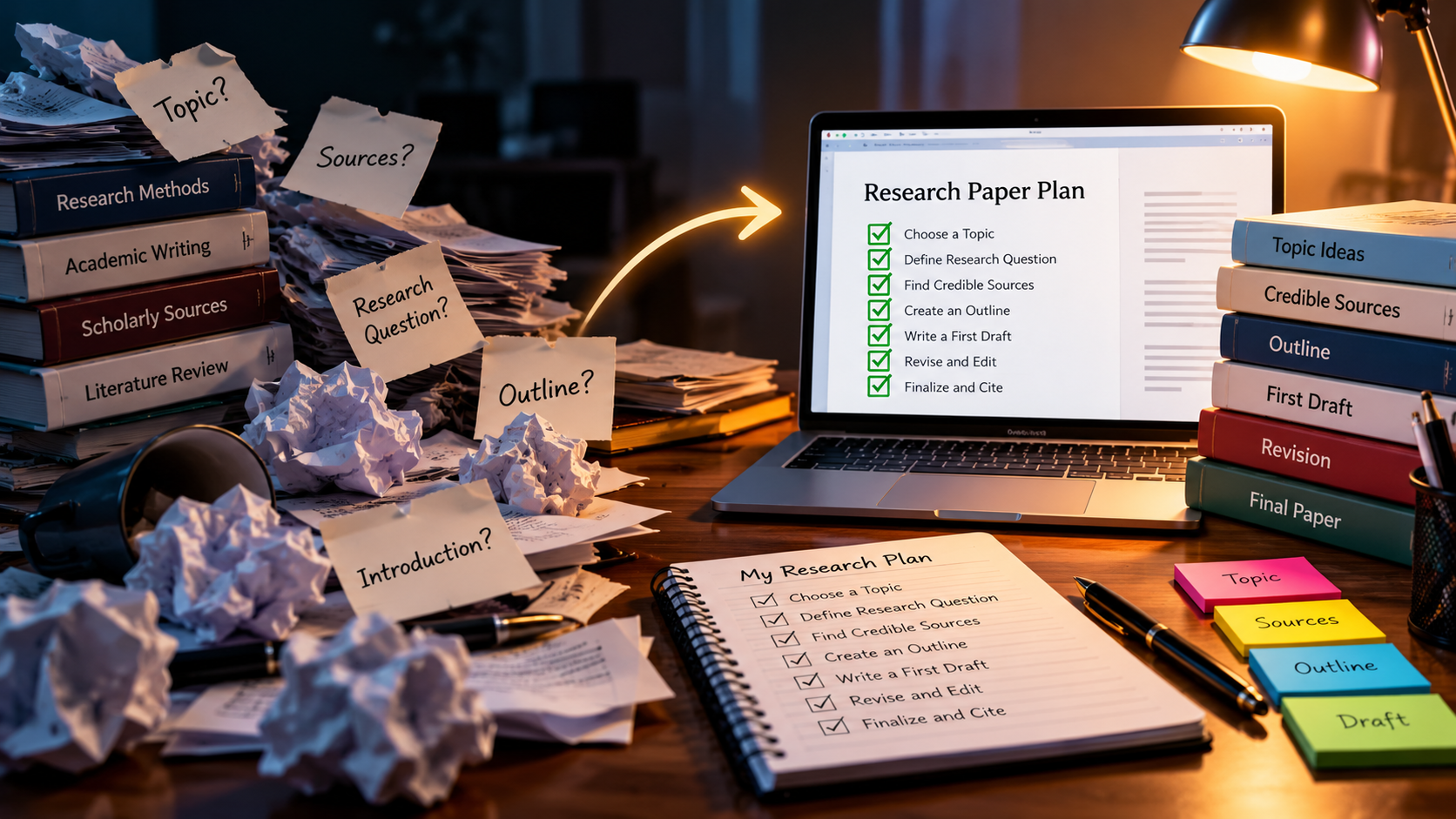
Quick action: Create a document called "Research Paper Plan" and record your requirements before researching anything.
Step 1: Choose a Topic You Can Actually Research
One common reason students struggle to begin is choosing a topic that's too broad.
Imagine selecting "Social Media" as your research topic. Where would you begin? Social media includes education, mental health, politics, marketing, communication, and countless other subjects.
Instead, narrow your topic by choosing a specific population, problem, or outcome.
| Too Broad | More Focused |
|---|---|
| Social media | Social media use and sleep quality among college students |
| Climate change | How urban heat affects low-income neighborhoods |
| Artificial intelligence | AI writing tools and undergraduate learning habits |
| Mental health | Academic stress and sleep among first-year students |
Before finalizing your topic, ask yourself:
- Am I genuinely interested in this subject?
- Can I find credible academic research about it?
- Is it narrow enough for the assigned length?
- Does it match my professor's instructions?
If the answer to any question is no, refine the topic before moving forward.
Step 2: Turn Your Topic Into a Research Question
Knowing how to start a research paper also means understanding the difference between a topic and a research question.
A topic tells readers what you're studying. A research question identifies what you want to discover or explain.
Topic: Social media and college students.
Weak research question: Is social media bad?
Stronger research question: How is nighttime social media use associated with sleep quality among undergraduate students?
The stronger question identifies a specific behavior, population, and outcome.
You can develop research questions using:
- How: How does a particular factor influence an outcome?
- Why: Why does a specific problem occur?
- What: What patterns or relationships appear in existing research?
- To what extent: How strongly is one factor associated with another?
Avoid questions that can be answered with a simple yes or no unless your assignment specifically calls for that approach.
Try this: Write three possible research questions. Choose the one that is focused, researchable, and relevant to your assignment.
Step 3: Find Three Reliable Sources Before Writing
Students often make one of two mistakes: writing without researching or collecting dozens of sources before deciding what they need. Neither approach is efficient.
Start with three credible sources directly related to your research question.
Useful places to search include:
- Your university library's academic databases
- Google Scholar
- Peer-reviewed journals
- Government research publications
- Academic books and university publications
For example, if your research question concerns social media and sleep quality, try searching:
"social media use sleep quality university students"
You can also combine terms:
"college students" AND "sleep quality" AND "social media"
When evaluating sources, check the publication date, author qualifications, research methods, and relevance to your question.
Don't assume that a source is reliable simply because it appears near the top of Google.
What Should You Write Down From Each Source?
Create a simple research notes table:
| Source | Main Finding | How It Helps |
|---|---|---|
| Study A | Finding about student sleep patterns | Background |
| Study B | Finding about nighttime device use | Supporting evidence |
| Study C | Finding about student technology habits | Alternative perspective |
These are illustrative placeholders, not actual research findings. Replace them with information from studies you have read.
Keep full citation details from the beginning. This saves time and reduces referencing errors later.
If you need help understanding citation styles, read our APA vs MLA vs Chicago guide.
Step 4: Create a Simple Research Paper Outline
If you're still confused about how to start a research paper, don't force yourself to write the introduction first. Build an outline.
An outline turns a large assignment into smaller sections that you can work on individually.
Here's a basic structure for an argumentative or analytical college research paper:
Introduction
- Introduce the topic.
- Explain why the issue matters.
- Present your research question.
- State your provisional thesis or central argument.
Background or Literature Context
- Explain essential concepts.
- Summarize relevant existing research.
- Identify important debates or gaps.
Main Analysis
- Present your key arguments or themes.
- Support claims with credible evidence.
- Compare different perspectives.
- Explain how the evidence answers your question.
Conclusion
- Summarize the main findings or arguments.
- Answer the research question.
- Explain limitations or implications.
References
List every source you cited using the required referencing style.
Remember that not every research paper follows this exact structure. Empirical research reports may require separate methods, results, and discussion sections.
If your assignment requires a literature review, see our step-by-step literature review guide.
Quick action: Write three main section headings and two supporting points under each one. That's enough to begin a workable outline.
Step 5: Write the Easiest Section First
Here's something many students don't realize: you don't have to write your paper from beginning to end.
In fact, trying to create the perfect introduction before understanding your evidence can slow you down.
Instead, choose the section you understand best.
Maybe you already have a strong source explaining the background. Start there. Perhaps you have identified two opposing viewpoints. Write a paragraph comparing them.
Your first draft should focus on getting ideas onto the page, not producing perfect sentences.
A Simple First-Paragraph Formula
- Point: Introduce one idea.
- Evidence: Present relevant research.
- Explanation: Explain what the evidence means.
- Connection: Link the point to your research question.
For example:
Nighttime technology habits are an important area of investigation in student sleep research. To examine this relationship, researchers have studied patterns of device use and sleep outcomes among university populations. Comparing these findings may help explain whether timing, duration, or type of social media activity is most relevant to sleep quality.
This is an illustrative opening, not an evidence-backed conclusion. Any factual claims in your final paper must be supported by appropriate citations.
Don't worry if your first paragraph sounds rough. Revision comes later.
Step 6: Create a Realistic Writing Schedule
Learning how to start a research paper becomes much easier when you divide the work into specific tasks.
Instead of writing "finish research paper" on your to-do list, schedule smaller activities.
Here's an example for a student with seven days remaining:
| Day | Task |
|---|---|
| Day 1 | Review instructions, select topic, and form research question |
| Day 2 | Find and evaluate relevant academic sources |
| Day 3 | Create outline and organize research notes |
| Day 4 | Draft main sections |
| Day 5 | Complete remaining sections and introduction |
| Day 6 | Revise arguments, structure, and citations |
| Day 7 | Proofread, format, and submit |
Adjust the schedule according to your paper's length and research requirements. A major empirical project cannot realistically be completed using the same timetable as a short literature-based assignment.
If you're struggling to manage your workload, our time management guide for university students offers a practical planning approach.
Student tip: Set a 25-minute writing session with one specific goal, such as drafting a paragraph or evaluating two sources.
Small, completed tasks build momentum.
Step 7: Leave the Introduction and Abstract Until You Have Direction
Students sometimes spend hours rewriting their first sentence because they believe the introduction must be perfect. It doesn't.
Your introduction should explain the research problem, provide context, and guide the reader toward your central question or argument.
But it's often easier to refine once you know what the body of your paper actually says.
You can begin with a temporary introduction and revise it after completing your main sections.
The abstract is different. If your assignment requires one, it's generally best to write it after finishing the paper because it summarizes the completed work.
Our guide to writing a research paper abstract explains how to summarize your purpose, approach, findings, and implications.
What to Do If You're Still Stuck After 30 Minutes
Sometimes the problem isn't a lack of information. It's uncertainty about which task comes next.
When that happens, use this 30-minute restart plan:
- Minutes 1–5: Read your assignment and highlight the requirements.
- Minutes 6–10: Write one focused topic and one research question.
- Minutes 11–20: Find two relevant academic sources and record their main ideas.
- Minutes 21–25: Write three possible headings for your paper.
- Minutes 26–30: Draft five rough sentences under the easiest heading.
You don't need to complete your research in 30 minutes. The purpose is to replace hesitation with visible progress.
Once you have a working question, a few sources, and a short outline, the next step becomes much clearer.
Common Mistakes Students Make When Starting a Research Paper
Even after learning how to start a research paper, certain habits can make the process unnecessarily difficult.
Choosing a Topic That's Too Broad
A broad topic leads to unfocused research and disconnected paragraphs. Narrow your subject before collecting extensive evidence.
Using Sources Without Evaluating Them
Not every online article is suitable for academic research. Prioritize credible, relevant, and appropriately sourced material.
Writing Without a Research Question
Without a clear question or central purpose, your paper may become a collection of unrelated facts.
Trying to Perfect Every Sentence
Drafting and editing are different activities. Write your ideas first, then improve their clarity and structure.
Forgetting to Track Citations
Record source details as you research. Don't wait until the final hour to reconstruct your reference list.
For additional guidance, read our article on avoiding plagiarism in academic writing.
Your Research Paper Starting Checklist
Before moving into your full first draft, check whether you have:
- Read and understood the assignment instructions.
- Selected a focused, researchable topic.
- Written a clear research question.
- Located at least three relevant academic sources.
- Created a basic outline.
- Identified your first writing task.
- Planned time for revision and citations.
If you can check these items, you've already made meaningful progress.
For additional academic guidance, Purdue University's research paper starting guide explains the importance of understanding the assignment, researching, outlining, and revising.
Frequently Asked Questions
How do I start writing a research paper for the first time?
Begin by reviewing your assignment requirements, choosing a focused topic, and developing a research question. Find a few reliable sources and create a basic outline before attempting a complete draft.
What is the first step in writing a research paper?
The first step is understanding the assignment. Check the required topic, length, citation style, source requirements, and deadline. Then identify a researchable topic that fits those expectations.
Should I write the introduction first?
Not necessarily. Many students find it easier to draft the main sections before refining the introduction. Your introduction should accurately reflect the direction of the completed paper.
How many sources should I find before starting?
There's no universal number. Start with a few relevant academic sources to understand your topic, then expand your research based on your assignment requirements and the evidence needed.
What if I don't understand my research paper assignment?
Review the instructions carefully and identify what's unclear. Ask your professor, teaching assistant, or university writing center for clarification before spending hours researching the wrong topic.
Final Thoughts: You Don't Need a Perfect Start
Understanding how to start a research paper isn't about finding the perfect opening sentence. It's about making a series of practical decisions that move your assignment forward.
Start by understanding the requirements. Choose a focused topic, develop a research question, find reliable sources, and build a manageable outline.
Then write one section at a time.
If you need additional guidance with research planning, academic editing, or formatting, explore our academic support services to see what assistance is available.
Your first draft doesn't need to be perfect. It just needs to give you something meaningful to improve.