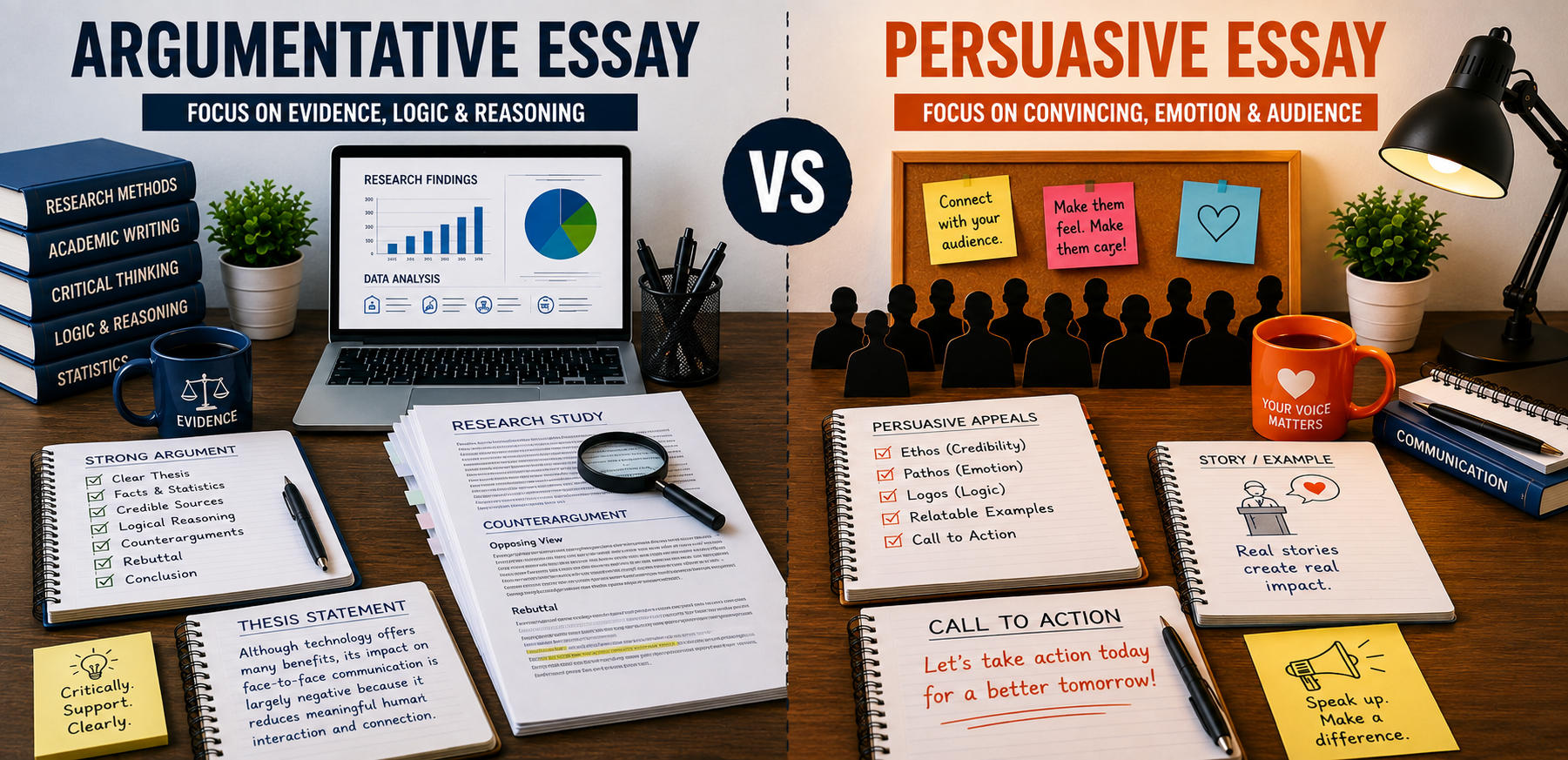
Students often encounter argumentative and persuasive essays throughout their academic careers, but the two forms of writing are easy to confuse. Understanding Argumentative vs Persuasive Essays is important because each requires a different approach to evidence, tone, structure, and audience. While both attempt to influence the reader, argumentative writing relies primarily on evidence and logical reasoning, whereas persuasive writing may combine facts with emotional and personal appeals.
Learning these differences can improve your Essay Writing, strengthen academic arguments, and help you choose an appropriate writing strategy for different assignments.
What Are Argumentative Essays?
An argumentative essay presents a clear position on a debatable subject and supports that position with evidence, reasoning, and credible sources. Its purpose is not simply to convince readers that the writer is correct. Instead, the writer develops a logical case that can withstand examination.
For example, an argumentative essay about online education might examine academic studies, student outcomes, accessibility data, and opposing viewpoints before reaching a conclusion.
Strong argumentative writing usually includes a thesis statement, supporting evidence, counterarguments, and a conclusion based on the evidence presented.
What Are Persuasive Essays?
A persuasive essay is designed to convince readers to accept a particular opinion, belief, or course of action. Evidence can still play an important role, but persuasive writing often gives writers more freedom to appeal to emotions, values, personal experiences, and the interests of their audience.
A student arguing that schools should provide healthier lunches, for instance, might use statistics alongside emotional examples about children's health and well-being.
This flexibility is one of the most important distinctions when comparing Essays.
Argumentative vs Persuasive Essays: Key Differences
Although the Argumentative vs Persuasive Essays types share some characteristics, several differences determine how they should be written.
1. Purpose
An argumentative essay attempts to establish that a position is reasonable based on available evidence. The writer is expected to demonstrate why the argument deserves serious consideration.
Persuasive essays focus more directly on influencing the reader. The desired result might be changing an opinion, encouraging action, or convincing someone to support a particular position.
2. Use of Evidence
Evidence is central to argumentative writing. Writers typically rely on academic research, statistics, expert opinions, credible publications, and other verifiable sources.
Persuasive essays may also contain evidence, but writers can combine factual material with anecdotes, emotional appeals, examples, and personal observations.
For students completing Research Paper Writing, learning to distinguish strong evidence from unsupported claims is especially important. Additional information about Research Paper Writing can help students understand the broader research process and requirements involved in academic papers.
3. Emotional Appeals
Another major distinction in Argumentative vs Persuasive Essays is the role of emotion.
Argumentative writing generally emphasizes logic. Emotional language should not replace evidence or distort the opposing position.
Persuasive writing can deliberately use emotional appeals. A persuasive essay about animal shelters, for example, might describe the experiences of abandoned animals to encourage readers to support adoption programs.
4. Treatment of Opposing Views
Argumentative essays normally acknowledge competing viewpoints. A strong writer explains the opposing position fairly before showing why the available evidence better supports another conclusion.
Persuasive essays may discuss opposing opinions, but extensive analysis of counterarguments is not always necessary. The writer's primary objective remains convincing the intended audience.
This difference becomes especially important in advanced Assignment Writing, where instructors may specifically require counterarguments and rebuttals.
5. Tone and Writing Style
Argumentative essays usually maintain a formal, balanced, and analytical tone. Writers should avoid presenting personal feelings as though they were objective evidence.
Persuasive essays can have a more direct and engaging voice. Rhetorical questions, vivid examples, calls to action, and carefully selected emotional language may be appropriate depending on the audience.
Structure of an Argumentative Essay
Understanding structure makes the distinction between Argumentative vs Persuasive Essays clearer. A typical argumentative essay may contain:
- An introduction establishing the issue
- A clear thesis statement
- Body paragraphs presenting evidence
- Analysis explaining why the evidence matters
- Counterarguments and rebuttals
- A conclusion based on the argument
The structure should guide readers logically from the original claim through the supporting evidence to the final conclusion.
Structure of a Persuasive Essay
A persuasive essay often begins by capturing the reader's attention before establishing the writer's position. The body then develops reasons designed to make that position compelling.
The structure might include an attention-grabbing introduction, a clear opinion, supporting reasons, examples or evidence, emotional or ethical appeals, and a conclusion containing a call to action.
Effective Essay Writing requires students to choose the structure that matches the purpose of the task rather than treating every essay as the same type of academic paper.
Which Essay Type Should You Choose?
When deciding between Argumentative vs Persuasive Essays, begin with the instructions provided by your teacher or institution. If the task requires extensive research, evidence, counterarguments, and objective analysis, an argumentative approach will usually be more suitable.
If the goal is to influence an audience, advocate for a change, or encourage a particular action, persuasive writing may provide greater flexibility.
The topic can also influence your decision. Complex academic controversies often work well as argumentative essays because they require careful consideration of multiple perspectives. Issues involving personal values or calls for action may be better suited to persuasive writing.
Common Mistakes Students Should Avoid
Students sometimes weaken argumentative essays by relying too heavily on personal opinions without providing reliable evidence. Another mistake is ignoring information that challenges the thesis. A credible argument should engage seriously with relevant opposing evidence.
In persuasive writing, students may make the opposite mistake by assuming emotional language alone will convince readers. Effective persuasion still requires logical reasons and trustworthy information.
Whether you are completing Essay Writing, Assignment Writing, or Research Paper Writing, always check the required format, evaluate your sources, and ensure that each paragraph contributes to your central purpose.
Final Thoughts
The main difference between Argumentative vs Persuasive Essays lies in how writers attempt to influence their readers. Argumentative essays emphasize evidence, logical reasoning, counterarguments, and objective analysis. Persuasive essays can combine evidence with emotional, ethical, and personal appeals to influence an audience.
Neither approach is automatically better. The correct choice depends on the assignment, topic, audience, and intended outcome. Once students understand these distinctions, they can build stronger arguments, select better evidence, and approach academic writing with greater confidence.